

Why Fabric Feels Heavy: GSM, Drag, and The “Lead Coat” Effect
Understanding why fabric feels heavy requires looking beyond just the scale; it is often a combination of high density (GSM), poor weight distribution, and moisture absorption.
You put on a winter coat. Five minutes later, your shoulders ache, and you feel exhausted. You switch to a different jacket that actually weighs more on the scale, yet it feels like wearing a cloud. How is this possible?
From a physics standpoint, perceived fabric heaviness is driven by pressure distribution, leverage, and friction—not just mass.
The sensation of “heaviness” in clothing is often a trick of physics. It isn’t just about gravity; it’s about leverage. When clients ask why fabric feels heavy, they are usually fighting against a garment that is poorly balanced or actively fighting their movement.
Quick Answer: Why Fabric Feels Heavy
Fabric feels heavy when weight is poorly distributed, stiffly draped, moisture-loaded, or pulled from the neck instead of resting on the shoulders.
1. High GSM (Actual Weight): The fabric is literally dense (e.g., heavy denim vs. silk).
2. Poor Drape (Stiffness): Stiff fabrics don’t mold to you; they “sit” on you, creating concentrated pressure points.
3. The “Drag” Effect (Fit): If a garment doesn’t fit your shoulders, it hangs off your neck, creating leverage that feels heavier than it is.
4. Moisture Load: A damp cotton shirt weighs significantly more than a dry one.
At Wovqo, we believe your clothes should support you, not burden you. Here is the science of why your wardrobe is weighing you down.
1. The Numbers: What is GSM?
In the textile world, we measure weight in GSM (Grams per Square Meter). This is the literal density of the weave.
-
Lightweight (Under 150 GSM): Chiffon, Linen, Voile. (Feels like nothing).
-
Medium Weight (150–350 GSM): Oxford shirts, Chinos, standard Merino wool.
-
Heavy Weight (350+ GSM): Raw Denim, Canvas, Melton Wool.
The Trap: Cheap synthetic fabrics often have a high GSM because the plastic fibers are thick and poorly spun. You might be buying a “summer dress” that has the density of a winter tarp.
2. The “Stiffness” Factor (Drape vs. Weight)
Imagine carrying a 10lb wooden plank vs. a 10lb chain-link blanket. The plank feels heavier because it is stiff and awkward. The chain flows. This is called “Drape.”
-
Good Drape: Fabric (like Rayon or Silk) makes contact with your whole body, distributing its weight evenly across your skin.
-
Poor Drape: Stiff fabric (like Canvas or starched Cotton) creates “tents.” It only touches you at the shoulders and hips, concentrating all 100% of the weight on those two spots. This makes it feel twice as heavy.
3. The “Neck Drag” (Bad Tailoring)
This is the #1 reason coats cause fatigue. Your shoulders are designed to carry weight (like a backpack). Your neck is not. If a jacket has armholes that are too low or a yoke that is too narrow, the garment slides back. The collar digs into your cervical spine. You aren’t wearing the coat; you are dragging it. (If your clothes feel restrictive as well as heavy, check our guide on [[Why clothes feel tight sometimes]] to distinguish between fit issues and bloating).
4. The Hidden Weight: Moisture
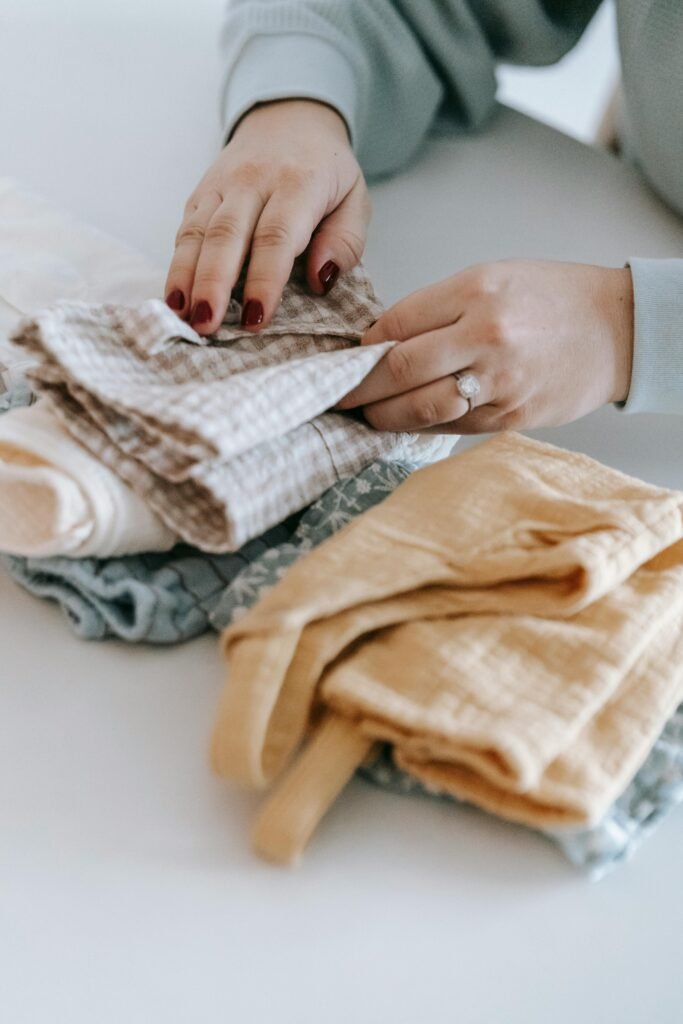
Your shirt is a sponge. Hydrophilic fibers (like Cotton and Wool) can absorb up to around 30% of their weight in water without feeling “wet.” If you live in a humid climate, your “light” cotton shirt is constantly pulling moisture from the air. By 2:00 PM, you are literally carrying around extra water weight. The Fix: Switch to hydrophobic fabrics like Linen or treated performance blends that repel ambient moisture.
Real-Life Micro-Story: The “Heavy” Wedding Dress
“A bride came to me complaining that her silk wedding dress felt ‘crushing.’ She wanted to switch to a lighter polyester dress. I weighed them. The silk dress was actually 2 lbs lighter than the polyester one. The Problem: The silk dress relied on thin straps that dug into her shoulders. The polyester dress had a corset structure that rested on her hips. The Fix: We added a waist stay (an inner belt) to the silk dress. Suddenly, the weight transferred to her hips, and she said it felt ‘weightless.'”
 The Lightweight Shopping Checklist
Before you buy, run the garment through this quick filter:
-
Check the Drape: Does it flow like water, or stand up like cardboard? (Flow is lighter).
-
Check the Fit: Does the weight rest on your shoulders/hips, or pull on your neck?
-
Check the Fiber: Avoid hydrophilic fabrics (100% thick cotton) if you live in high humidity.
Final Thoughts: The Shoulder Test
When shopping, don’t just look in the mirror. Close your eyes. Bounce on your heels. Where do you feel the garment landing?
-
Good: The weight vanishes or settles on your core/hips.
-
Bad: You feel a distinct pull on your trapezius muscles (base of the neck).
If it feels heavy in the dressing room, it will feel like armor after an 8-hour day. Put it back.
(To ensure you’re picking fabrics that work for your climate, read our analysis on [[Is this fabric breathable in heat?]]).
Frequently Asked Questions
Does polyester feel heavier than cotton?
Usually, yes. While the fibers themselves are light, polyester doesn’t breathe. It traps heat and humidity inside the garment, creating a “micro-climate” that feels heavy and suffocating, even if the GSM is low.
Why do my jeans feel heavier after I wear them?
They have stretched out. Fresh from the wash, jeans are tight and rely on friction against your legs to stay up. As they loosen, they slide down, meaning your hips have to work harder to hold them up, or they drag on your belt, creating a sensation of heaviness.
What is the heaviest fabric?
Canvas and Denim. Heavyweight raw denim can go up to 20oz (approx 600 GSM). While durable, these fabrics have zero drape and require a long “break-in” period before they mold to the body and stop feeling like a suit of armor.
