

How to Fix Fitting Issues: The “Off-the-Rack” Survival Guide
It is the most discouraging moment in fashion. You take three sizes into the dressing room. The Small is too tight across the chest. The Medium fits your waist but the sleeves are too long. The Large looks like a potato sack.
You stand there looking in the mirror and think: What is wrong with my body?
The answer is: Absolutely nothing.
Clothing manufacturers design for “The Average.” But “The Average” is a mathematical ghost—nobody actually has those exact measurements. When analyzing how to fix fitting issues, we have to stop expecting clothes to fit perfectly off the rack and start viewing them as a “first draft.”
 Quick Answer: How to Fix Fitting Issues Using “Alteration Triage”
Before you buy (or cry), you need to know which problems are fixable and which are fatal.
The Fix-It Cheat Sheet (TL;DR)
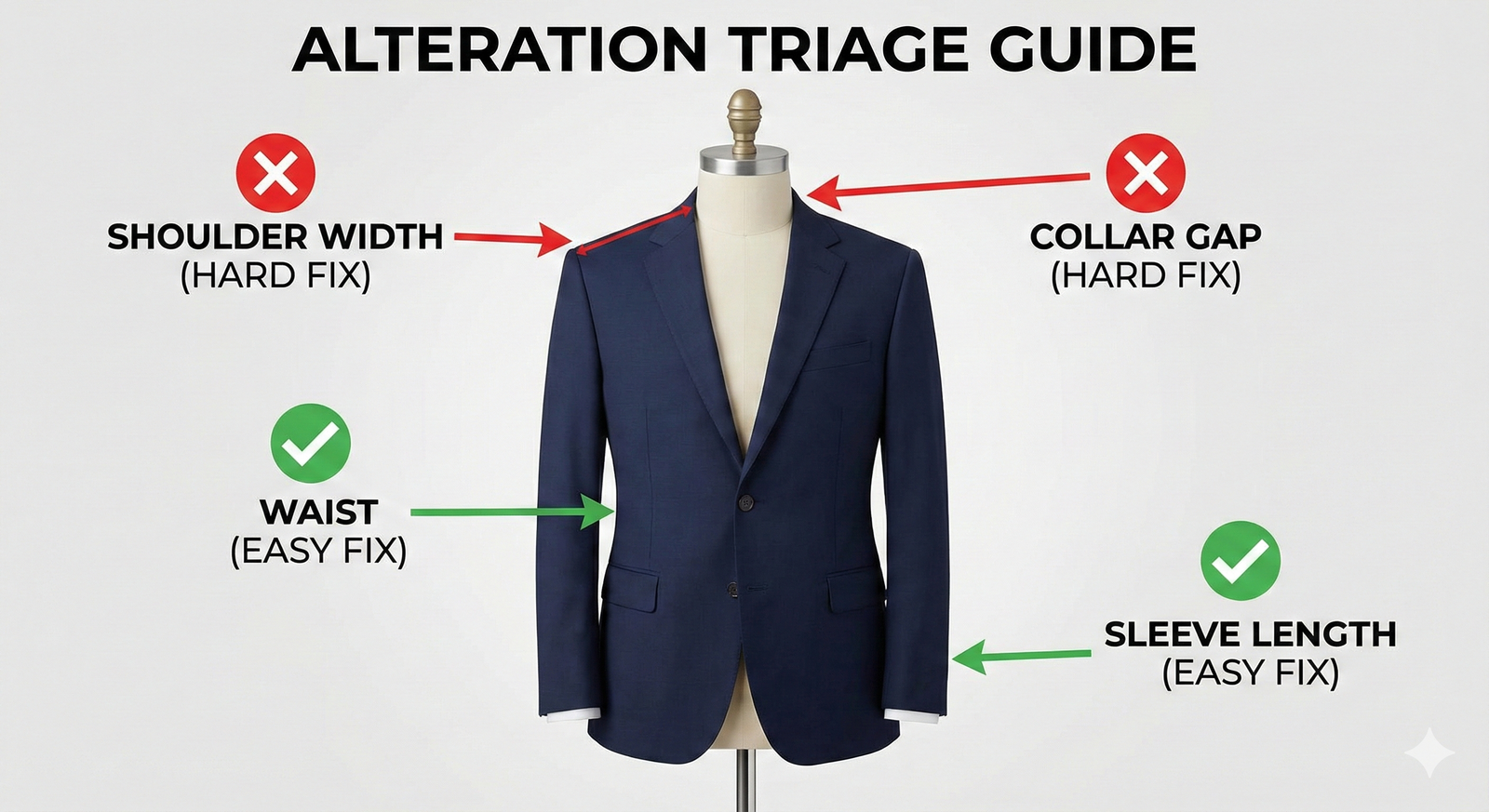
Easy Fix ($): Hemming pants, taking in the waist, shortening sleeves.
Hard Fix ($$$): Tapering a jacket, lifting shoulders, changing a neckline.
Impossible Fix (Don’t Buy): Shoulders are too narrow, the “rise” (crotch) is too short, or the fabric is pulling at the buttons.
The Golden Rule: Buy for the largest part of your body. It is easy to take fabric in (make it smaller). It is nearly impossible to let fabric out (make it bigger).
 Instant Decision Guide: Should You Buy It?
-
Buy it immediately → Shoulders fit perfectly.
-
Buy and tailor → Too big in waist, sleeves, or length.
-
Try different size → Minor tightness, minor looseness.
-
Do NOT buy → Tight shoulders, pulling buttons, short rise.
 The “Emergency Fit” Kit
Keep these three tools in your drawer for instant fixes without sewing:
-
Fashion Tape: Secure a gaping blouse or a sliding strap instantly.
-
Safety Pins: Temporarily cinch a waist or close a split seam.
-
Hemming Tape (Iron-On): Shorten pants permanently with just an iron—no needle required.
1. The “Foundation” Rule (Watch the Shoulders)
If you only remember one thing, remember this: The shoulders are the bones of the garment. If a blazer or coat doesn’t fit your shoulders perfectly, put it back. Tailoring shoulders requires ripping the entire jacket apart.
Professional tailors consider shoulder fit the most critical factor because every other part of the garment hangs from that structure. Check out our guide on how to spot quality construction to identify good shoulder stitching.
The Fix: If the shoulders fit but the waist is baggy, buy it. A tailor can nip the waist in for $20, giving you a custom hourglass look.
2. The “Gaping Waist” Problem
This is the most common issue for anyone with curves (hips wider than waist). You buy jeans that fit your thighs, but you can fit a whole fist in the gap at your back. Don’t rely on a belt. Belts bunch the fabric and ruin the silhouette.
The Pro Fix: Ask a tailor to add “darts” (small triangular folds) to the back waistband. According to professional tailoring guides, adding darts is a standard, affordable alteration that completely transforms how pants sit on your body.
3. The “Pooling” Hem (Too Long)
Pants that bunch up at your shoes make you look shorter and sloppier. Many brands now sell “tall” or “petite” lengths, but they are rarely perfect. The Secret: The perfect hem depends on your shoes.
-
For Heels: The hem should sit 1/2 inch off the floor.
-
For Flats/Sneakers: The hem should just graze the top of your shoe (no break).
Elite Insight: If you are short, cropped pants are your best friend. Showing a little ankle breaks up the visual line and makes your legs look longer.
 Do NOT Buy It If…
 The “Whiskers” appear. (If horizontal lines pull across your lap or chest, the garment is too tight. Sizing up is the only fix). The pockets pop open. (This means the hip measurement is too small. Don’t try to sew them shut; just size up). The fabric is sheer. (You can’t fix cheap fabric with tailoring).
Why: You can change the shape of a garment, but you can’t change the physics of the fabric.
Real-Life Micro-Story: The “Thrift Store” Suit
“I found a designer wool blazer at a thrift store for $10. It was two sizes too big. I looked like a child wearing my dad’s coat. But the shoulders fit perfectly. I spent $50 at a tailor to shorten the sleeves and take in the torso. Total cost: $60. People ask me constantly where I got my ‘custom’ suit. I didn’t buy a custom suit; I built one.”
This is why experienced dressers evaluate garments based on alteration potential, not rack fit.
The Lesson: The price tag doesn’t determine the fit. The tailor does.
Final Thoughts: Clothes Are Malleable
Stop fighting your body. Start manipulating the fabric.
Understanding how to fix fitting issues gives you power. You stop being a passive consumer (“I hope this fits”) and become an active stylist (“I can make this fit”).
 The 10-Second Fit Test
-
Shoulders sit flat
-
No pulling lines
-
Waist can be adjusted
-
Length can be hemmed
-
Fabric looks structured
-
If all 5 pass → Buy confidently.
The most stylish people in the room aren’t the ones with the best bodies. They are the ones with the best tailors.
Frequently Asked Questions
Q: Can you make clothes bigger? A: Rarely. Most modern mass-produced clothes have very small “seam allowances” (extra fabric inside), making it difficult to let them out more than half an inch. It is always safer to buy big and take in.
Q: Does dry cleaning shrink clothes? A: It shouldn’t, but heat does. If your dry cleaner uses excessive heat during pressing, wool can shrink. Check out our full guide to fabric types to understand which materials are most vulnerable to heat damage.
Q: How do I find a good tailor? A: Start with a simple job (hemming jeans). If they do a good job on the basics, trust them with your expensive blazer. A bad hem is fixable; a bad suit alteration is forever.
