
Why Fabric Traps Heat: The “Sauna Effect” Explained
It is the classic summer betrayal. You buy a lightweight, flowy summer dress or shirt. It feels thin. It looks breezy. But ten minutes after stepping outside, you feel like you are wrapped in cling film. You are sweating, but the air isn’t reaching your skin. You are wearing a portable sauna.
You wonder: It’s so thin—why am I dying of heat?
The answer is usually on the care tag.
To understand why fabric traps heat, we have to stop looking at the weight of the fabric and start looking at the structure. Heat doesn’t care how heavy the cloth is; it cares if the doors are open. Some fabrics are like screen doors (Linen), while others are like glass windows (Polyester)—lightweight, but completely airtight.
 Quick Answer: The “Breathability” Hierarchy
Fabric traps heat when it blocks airflow and prevents sweat from evaporating—usually due to synthetic fibers, tight weaves, or plastic linings.
The Cool-Down Cheat Sheet (TL;DR)
The Open Door (Cool): Linen & Cotton. These fibers are hollow and absorbent. They let heat escape like steam from a vent.
The Closed Door (Warm): Silk & Wool. They regulate temperature but are tighter structures. Good for mild days.
The Plastic Bag (Hot): Polyester, Acrylic, Nylon. These are solid plastic filaments. They trap body heat against your skin, creating a greenhouse effect.
 Instant Decision Guide: What Should You Wear?
-
Sitting still in heat (Office/Brunch)? → Linen or Cotton. (You need air flow).
-
Moving fast (Gym/Running)? → High-Tech Polyester. (You need sweat-wicking, not breathability).
-
Humid weather? → Loose Rayon/Viscose. (Avoid tight cotton; it stays wet).
1. The “Straw vs. Rod” Science
Why does cotton breathe while polyester suffocates? Imagine drinking a soda.
-
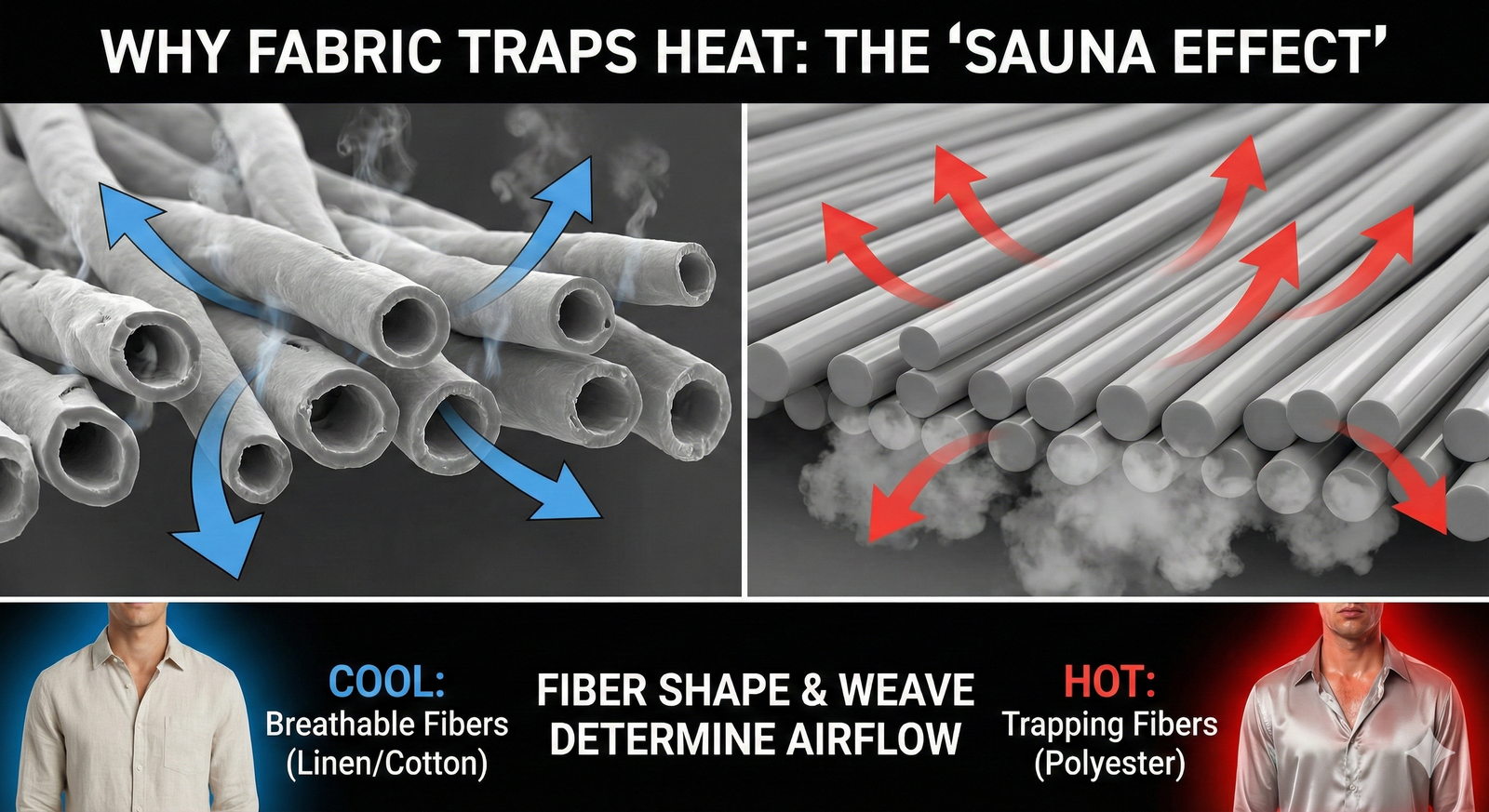
Natural Fibers (Cotton/Linen): Are like a straw. They are hollow. They absorb moisture inside the fiber itself and move it to the outside air.
-
Synthetic Fibers (Polyester): Are like a solid plastic rod. Moisture cannot go inside the fiber. It sits on top. When you wear polyester, it doesn’t absorb moisture, so heat and humidity stay trapped near your skin.
Textile Physics Insight: Textile comfort research consistently shows that moisture retention and airflow—not thickness—are the primary drivers of thermal comfort.
(If you want to know which synthetics are actually worth buying, check out our guide on [[Understanding fabric types]] to spot the difference between cheap poly and high-tech blends).
2. The Weave Factor (It’s Not Just the Fiber)
Even a “cool” fiber can be made hot if it is woven incorrectly. Think of Denim. It is 100% cotton, but it is hot. Why? Because it is a Twill Weave—the threads are packed so tightly that air cannot pass through. Contrast that with Chambray or Poplin. Same cotton, but a looser “plain weave.”
The Trap: Satin. Satin is a weave, not a fiber. A “Polyester Satin” blouse is the ultimate heat trap. It combines a solid fiber (poly) with a tight weave (satin). It is essentially a heat trap despite its glossy appearance.
(Make sure you aren’t overpaying for bad weaves. Read our guide on [[How to spot quality clothing]] to learn how to check weave density in seconds).
3. The Lining Lie
This is the hidden saboteur in formal wear. You buy a beautiful, expensive wool suit or a linen blazer. The shell is breathable. But you are still sweating. Check the lining. Most brands save money by lining breathable jackets with cheap polyester or acetate. You have wrapped a breathable house in plastic siding. Elite Insight: If you can’t afford a silk-lined jacket, look for “unlined” or “butterfly lined” blazers. They maximize airflow. (Read our guide on [[How to fix fitting issues]] to understand how unlined jackets should drape).
 Do NOT Wear This In Summer
 Do NOT wear “Wrinkle-Free” Cotton. (It is treated with a resin coating that closes the pores of the fiber, which can significantly reduce breathability). Do NOT wear Grey Polyester. (When sweat sits on top of synthetic fiber, it turns dark grey instantly. It is the most unforgiving color/fabric combo). Do NOT ignore the “Acrylic” label. (Acrylic is designed to mimic wool warmth. Wearing an acrylic knit in summer is asking for heatstroke).
Why: Style should never cost you your comfort.
 The Micro-Structure Guide
File Name: linen-vs-polyester-microscope.jpg Alt Text: Why fabric traps heat – microscope view of breathable linen fiber vs solid polyester plastic Caption: Linen (left) looks like bamboo with gaps for air. Polyester (right) looks like smooth, solid wire.
Real-Life Micro-Story: The “Summer Wedding” Regret
“I attended an outdoor wedding in July. I wore a cheap polyester blend suit because it looked sharp and didn’t wrinkle. My friend wore a rumpled linen suit. By 2 PM, I was drenched in sweat, my shirt sticking to my back. My friend looked breezy and cool. I realized that my ‘wrinkle-free’ look came at the cost of being wrapped in plastic. I haven’t bought a poly suit since.”
The Lesson: Wrinkles are better than sweat stains. Embrace the texture of natural fibers.
Final Thoughts: Read the Tag, Not the Brand
Marketing lies (“Cool-Touch Technology!”), but the care tag tells the truth.
To understand why fabric traps heat, simply ask: Is this plastic or plant? If you want to stay cool, choose plants (Cotton, Linen, Bamboo). If you want to trap heat (or survive a rainstorm), choose plastic (Polyester, Nylon).
Not all synthetics are bad—engineered performance fabrics can outperform natural fibers in high-intensity use. But for daily wear, nature usually wins.
If you are struggling to build a wardrobe that works for all seasons, you need a strategy. (Read complete guide on [[How to build a capsule wardrobe]] that actually saves money).
Dress for the weather, not just the mirror.
Frequently Asked Questions
Q: Is Rayon cooler than Cotton? A: Often, yes. Rayon (and Viscose/Lyocell) is a semi-synthetic made from wood pulp. It is thinner and drapes better than cotton, making it feel cooler to the touch, though it absorbs slightly less sweat.
Q: Why do gym clothes use Polyester if it traps heat? A: Because of Wicking. While polyester traps heat, high-end gym gear is engineered to move water. It pulls sweat off your skin to the surface where it evaporates. Cotton holds the sweat like a wet towel.
Q: Does dark fabric actually make you hotter? A: Yes. Physics dictates that black absorbs more solar radiation (heat) than white. However, the fabric type matters more. A black linen shirt is cooler than a white polyester shirt.
