Is This Brand Worth the Price? The 3-Step Quality Check Before You Buy
It is the ultimate shopping dilemma. You are holding a beige trench coat. One tag says $80. The other tag says $800. You touch them. The fabric weight feels the same. The buttons click the same. So why is one ten times the price?
So how do you really decide: is this brand worth the price, or just good at marketing?
In the modern fashion industry, price is rarely a reflection of quality. It is a reflection of marketing. We have seen $2,000 designer bags made of plastic (PVC) and $50 vintage wool coats that last a lifetime.
When we stop looking at the tag and start looking at the construction, the answer becomes clear. You don’t need to be a tailor to spot a rip-off. You just need to know where to look.
 Quick Answer: The “Cost Per Wear” Formula
Before you tap your card, do this mental math. This is the only metric that actually matters.
The Value Equation: Price of Item ÷ Number of Times You Will Wear It = Real Cost
-
The “Cheap” Dress: $50 ÷ 2 wears (it shrinks/rips) = **$25.00 per wear**. (Expensive!)
-
The “Investment” Jacket: $300 ÷ 150 wears (3 winters) = **$2.00 per wear**. (Cheap!)
The Golden Rule: If you can’t imagine exactly where you will wear it 5 times in the next month, put it back. It’s not worth the price, no matter how cheap it is.
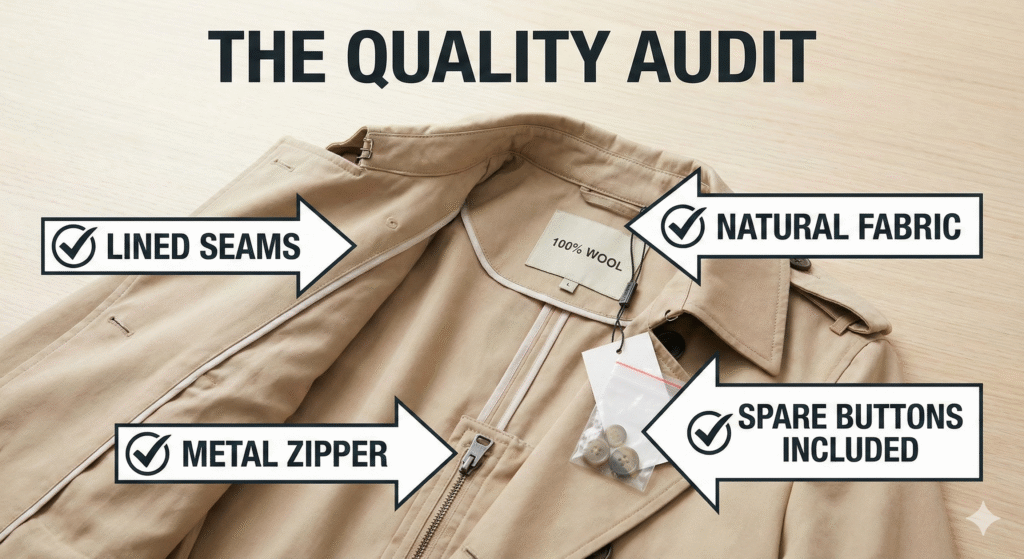
 The 30-Second Quality Audit
Scan this checklist before you buy to avoid regret:
-
 Check fabric tag: (Natural fibers > Synthetic for basics)
 -
Flip inside-out: (Clean seams, no loose threads)
-
Test zipper: (Smooth metal = good sign)
-
Calculate Cost Per Wear: (Will I wear this 30 times?)
1. The “Inside-Out” Test (Construction)
Brands spend millions making the outside of a garment look perfect. They spend pennies on the inside. Flip the garment inside out. This is where the truth lives.
-
The Stitching: Is it straight and tight? Or is it loose and snagged? If you see loose threads on a brand new item, it will fall apart in the wash.
-
The Pattern Match: Look at the seams. If the stripes or plaids don’t line up perfectly at the shoulder or side, the brand cut corners to save fabric.
-
The Lining: High-quality jackets use natural linings (like Cupro, Viscose, or Cotton). Cheap brands use Polyester, which traps heat and makes you sweat.
Elite Insight: Check the buttons. Are they plastic or natural (horn, mother of pearl)? Are they sewn on securely? Loose plastic buttons are the #1 sign of a markup that isn’t earned.
2. The Fabric Reality Check
Marketing is deceptive. A sweater labeled “Cashmere Blend” might only contain 5% cashmere and 95% acrylic. According to textile industry reports, fabric accounts for only 20–30% of a garment’s retail price. The rest covers branding, marketing, and retail markup.
read our full guide to fabric types
Always read the care label (usually hidden on the left inner seam).
-
Synthetics (Polyester, Acrylic, Nylon): These are essentially plastic. They don’t breathe, they retain odors, and they pill (get fuzzy) quickly. They are cheap to produce but often sold at high prices.
-
Natural Fibers (Wool, Cotton, Silk, Linen): These breathe, age well, and regulate body temperature.
Warning: If a brand is charging over $100 for a 100% Polyester dress, you are paying for the marketing, not the garment.